Wednesday, 25 June 2014

Where did France go?!?

Hmmm, last time I wrote a blog post we were just leaving Spain. Now we're in Italy! I seemed to have skipped an entire country...

Excuses:
I've been meaning to write something for a while but:
a) no one particular event seemed to stand out at the time as the subject for a post
b) after nearly six months, living in the van has come to feel so normal that it doesn't seem worthy of comment
c) more geekily, (and probably the real reason for the lack of post) I discovered qPython for Android, so I can now mess about improving my programming EVERY EVENING, instead of just when I've managed to charge my laptop!

France was the second leg of the single-pitch sport climbing part of the trip. As Andy's already alluded to in his posts, in terms of climbing progress France probably wasn't as kind to us as Spain had been.  We had a bit of bad luck (or was it bad planning?) with soaring temperatures and injury niggles getting in the way.  Still, we visited quite a few cool places...

First few days:
We started off with a few days on the Ariege, on the French side of the Pyrenees. I had a fun couple of afternoons on a granite outcrop near Auzat. Out of curiosity, I tried to visit the Hypocras factory in Tarascon, where they make a medieval aperitif out of wine and spices, but it was 'Fermée Exceptionellement' on that particular afternoon...

The intended main event:
Cal on 'Les Culottes de ma Grandmere'

We next headed to Gorge du Tarn, near Millau, where we'd intended to spend several weeks. The first week was great - we met up with two of Andy's Kilnsey friends, Rachel and Cal, and tried a variety of things in the Tarn itself, and at Le Boffi, a nearby crag we'd been to before. I'd never visited the Tarn properly before, and it's now definitely on my 'to come back to' list. It's a beautiful, atmospheric place, with amazing rock architecture. The climbing is quite special too - the normal routes are spectacular enough in their own right, but there are several enormous 70-80m routes specifically bolted to be climbed as one massive, uninterrupted megapitch. We didn't do any this time, but possibly something for the future - maybe after buying a longer rope...

Injury time:
Unfortunately, after about a week in the Tarn, both of us started feeling broken. Andy had a tweaky shoulder and I developed golfers elbow, a common RSI in climbers. We decided it was time for some time off. We started with some walking around the Tarn area, exploring the gorge from a different perspective, but it became clear that our niggles weren't going anywhere fast and we needed a proper break from climbing. So we drove south and spent a few days beaching and exploring the Camargues near Montpellier: Andy wrote in more detail about this here.

Camargue wildlife

(I don't think he mentioned the white horses though - the area's famous for its indigenous breed of Camargue horses, many of which live semi-wild on the marshes).
Camargue horses

Next steps:
a storm front blew in after that so we escaped eastwards and eased ourselves back into climbing. The first stop was Chateauvert, near Brignoles, with John, a friend met through North London MC. After that we moved on to Saint Leger and Malaucene, some crags which are near Mt Ventoux of Tour de France fame (Top tip: if you decide to drive up this famous road biking landmark on a whim, make sure it's not a bank holiday Saturday!) Again, Andy already wrote about this part in more detail...

My experiences: Chateauvert is all about sustained, slightly overhanging climbing on scoopy pockets - I was pleasantly surprised to discover that I have become fit! Compared with the beginning of the trip (and when I visited Chateauvert a few years ago), I can now hold on for ages! On the other hand, my lead head (and on a couple of occasions my toprope head) seemed to have regressed again to zero, probably due to the loss of momentum caused by the injury timeouts.

The last day at Chateauvert was scorching, and that weather pattern continued for the next couple of weeks. Climbing in the sun became pretty much impossible. Apart from one day at Malaucene, which made my elbows hurt, I split my time in the Ventoux area between belaying Andy on the shady bit of Saint Leger,  and sitting in the river...
La Baleine is a good place to escape the heat......but the river is better!

The next stop was Orpierre, a bit further east, near Sisteron. On paper, this was an ideal crag for us - a whole wall of easy routes that I thought I could use to rebuild my momentum, right next to some 8a's for Andy to try. And it all came into the shade at about 1 pm, which suited my morning habits perfectly. Unfortunately, it turned out to be so hot and muggy that, even in the shade, we didn't get decent climbing conditions until more like 7pm - too much of a lazy morning even for me!

Star spotting at Ceuse:
A small part of Ceuse...

So we moved on to nearby Ceuse. As well as being described in our guidebook as 'the best crag in the world' (you can't go far wrong with that!), it has the added advantage of being at the top of a big hill, making it much less hot than the previous venues.  The downside, obviously, is that you have to walk up the aforementioned big hill to get to it... It was my first time at Ceuse and I was suitably impressed - it's also been added to the 'to come back to' list. I'll have to get a lot better first though - the other disadvantage of Ceuse (for the ego, at least) is that it's a difficult climbing style that's hard to do well at until you've got used to it. We both got resoundingly spanked...

Jonathan Siegrist on Biographie extension

Unsurprisingly, given the world-class reputation of Ceuse, there were a few famous climbers hanging around - the first time we've seen any on this trip. I'd assumed Catalunya would be the best place for star spotting, but the closest we got was hearing from a friend that Adam Ondra had been in Margalef about a week before we arrived. In Ceuse there was a group of American climbers filming Jonathan Siegrist trying the route Biographie and its famous extension. We got to see some of the magic of climbing film-making in action. The route's too long to film the actual successful ascent all in one go, so they were filming multiple attempts on different days to be edited together later. When we saw them they were filming a special hat removal scene to fix a continuity problem - they'd filmed him climbing the bottom section wearing a hat and the top section without it. We also saw Arnoud Petit (French climbing legend) hanging around the crag base doling out wisdom - this is probably less impressive though since he apparently lives at the bottom of the hill. Ueli Steck (famous for record-breaking solo speed ascents of Alpine north faces - e.g. North face of the Eiger in 2:47:33) was also staying at the campsite. We didn't actually see him, but we knew he was there because he has a special 'Ueli Steck' car that says 'Ueli Steck, www.uelisteck.ch' on it.

Summing up:
After a few days, the weather turned unsettled so we decided to move on, heading eastwards for the Alps. This marked the end of the proper sport climbing part of the trip. There may be some valley cragging on dodgy weather days, but the focus from now on is going to be on longer, mountain routes. But more on that later...
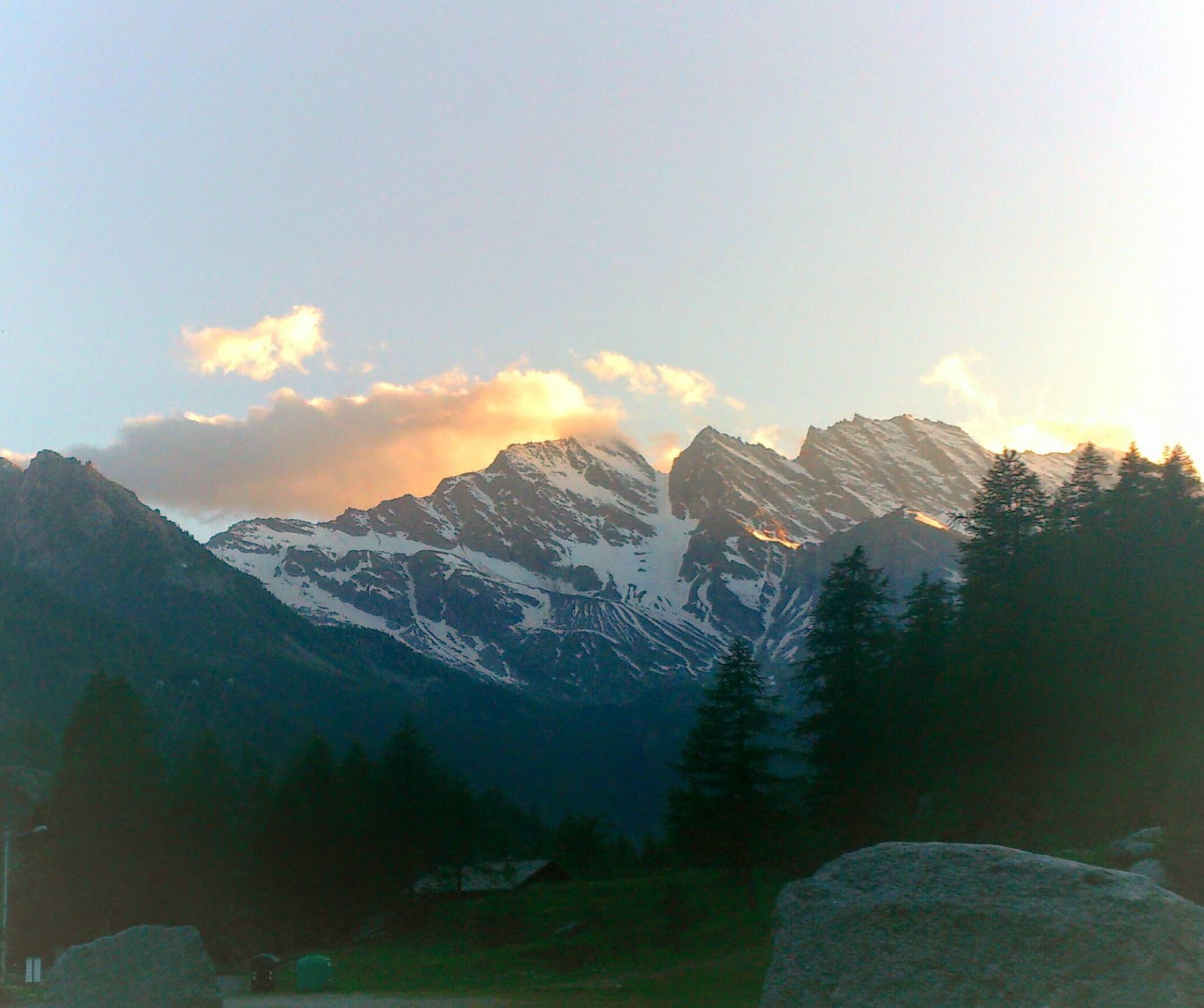
An Alp, in the distance...

Overall, the sport climbing tour of Spain and France has been fun, though I haven't made the gains in terms of climbing ability (at least when purely measured in grades) that I'd hoped I would. This was partly due to bad luck with injuries - I was definitely noticing some improvements before the finger injury - but probably also due to some tactical errors. I perhaps should have been a bit more disciplined about training my lead head (the biggest problem with my climbing) in the first month or so of the trip, trading some time spent doing some boring, unpleasant exercises in exchange for being able to climb well on a much wider variety of things later. At the time, however, I was quite happy to run around aimlessly leading easy things as and when I felt like it, and just hoping that improvement would happen by magic.

On the other hand, I'm feeling fitter than I've probably ever been, and this should only be improved by some time spent in the mountains. So this should give me a good base to work from when we get back, if I get organised and do some proper training over the winter. And having the opportunity to visit so many beautiful places has been amazing and really inspiring. I probably now have more on my list of places to visit again than will fit into one lifetime...

Tuesday, 6 May 2014

The end of the beginning

After four months of travelling we have finally left Spain. I'm sure France will be just as good, but still it's a little bit sad. Spain has a lot of rock - despite spending so long (nearly half the trip!) here we only explored a fraction of the country, and there's still so many climbing areas that we haven't visited.  It was starting to get a bit too hot for climbing though, so reluctantly we had to leave and head north.

Spain didn't seem to want to let us go either.  We meant to leave a few days earlier, but got delayed by an unfortunate series of events. The climbing shop that was resoling my climbing shoes seemed to have a stereotypically Mediterranean attitude towards being open during their advertised opening times.  Ryanair had a stereotypically Ryanair attitude towards cancelling our friend's flight (actually in this case it wasn't Ryanair's fault, but abusing them is fun...) And we had a slightly epic drive around Lleida province looking for a ferreteria that a) was open on a Saturday afternoon and b) had gas in stock.

We made it in the end though - I'm sitting in France as I write this! More on that later...  Leaving Spain definitely feels like coming to the end of the first stage of our trip, hence the post title. I've found myself mentally noting things we've done in the last couple of weeks as "the last time we'll do <insert thing here> in Spain". Here are a few of those 'lasts':

Last climbing in Spain:
Siurana village and cliffs (seen from Arboli)
After spending a lovely few days back in Barcelona with Maria, Chris and John, we headed to Siurana, near Tarragona.  Siurana itself is a tiny village perched on a hill, next to the ruins of a Moorish castle.  It's also a famous and extensive sport climbing area (one of the first true sport climbing areas to be developed in Catalunya).  We were joined for a few days by Simon, a friend from uni climbing days, and Liz, who climbed with us in Chulilla earlier in the trip.

Unfortunately, on my previous visits to Siurana I hadn't liked it very much - the climbing style involves small sharp holds, and the routes I'd tried tended to feel quite hard for the grade. I was a bit worried too about how my injured finger would cope. It had held up quite well to a gradual reintroduction of climbing, and after a few extra days of rest in Barcelona it was feeling really good. But for the type of finger injury I had, climbing on the small crimpy holds typical of Siurana was possibly the worst thing I could do to it!

It was not a promising start - I flailed like a giraffe on roller skates trying to toprope a 6b at sector l'Olla on day 1. On day 2 I failed to get more than 2m off the ground on the 6b+ "warm-up" route at el Pati because the savagely small holds at the start instantly tweaked my bad finger, and then got ludicrously scared toproping a 6b because it went a bit sideways. And it was windy. And I had a cold. I was feeling a bit miserable by this point, and was half considering just staying in bed for a few days.

Luckily, Liz had other ideas!  On day 3, she bullied me into trying a different 6b+ on toprope (I was just going to sit on the floor and feel sorry for myself but she was persistent), which turned out to be much nicer. Then we both had a toprope go on Crosta Panic, a 7a+ at sector el Pati, which is a level of difficulty I wouldn't normally have tried. I was quite surprised, both by how much of it I could actually do (at least, with a tight rope!) and by how nice the climbing felt - it seems like Siurana follows the pattern of several crags we've visited where it's important not to let struggling on the easy climbs put you off trying the harder ones.
Si pulling hard on Bistec de Biceps

The success of that day inspired me to keep on trying to toprope harder things (ie 7a/+, for me) over the next few days, both during the remainder of Liz and Si's scheduled visit, and Si's two bonus days when his flight home got cancelled.  I think their enthusiasm was infectious, and I was inspired by their efforts. Si did an impressively quick ascent of one of Siurana's most famous routes, Bistec de Biceps. And Liz was so, so close to redpointing Crosta Panic, which would have been her first 7a+, falling off the last move on the last day of the trip after having climbed for ten days straight without resting - a really good effort! Maybe, just maybe, if I tried that hard...

Overall, I left Siurana (finger still intact) in a much better frame of mind than when I arrived, and with the feeling that maybe it's not such a bad place after all!

Last food in Spain:


We stocked up at a supermarket on our way north, and I thought we should get something authentically Spanish for our last meal. Since Spain's famous for its pork products, we went for a selection of mini-sausages in four different flavours - chorizo, obviously, but also morcilla, longaniza and criollo which we'd not tried before. Verdict: tasty!

I spent a very long time in the cheese aisle too, choosing the perfect Last Cheese of Spain. I went for a mature, smoked sheep's cheese made with unpasteurised milk from local sheep - I thought this ticked an appropriate number of cheese-snob boxes! And some goat's cheese too because the first one didn't come in very big blocks.

Last water in Spain:
We filled up our water tank on the way north in Figols, a small village near Organya, where we'd spent some time previously. There was nothing particularly notable about this except that the fountain was shaped like a deer. This amused me.

Last view of Spain (almost):
This was the view of Siurana reservoir, where we spent our last night in Spain. Technically, I suppose, I did see other things in the 200-ish km between here and the Andorran border but I tried not to look at them too hard...
  
For completeness, this was the actual last view of Spain, as we were approaching the border with Andorra - it's nowhere near as good.

We were a bit delayed (again) getting to France by some entertaining-ness in Andorra (nothing bad happened but we now know how to change the wheels on the van!) We finally crossed the French border, via a mountain pass over the Pyrenees, late on Saturday evening. We were a bit tired and hungry by this point, so we just stopped the van in the first place we could, cooked our tiny sausages, ate and went to sleep without a clear idea of where we were. The next morning it turned out we were here:
Surprise view!

I like France so far!

Sunday, 20 April 2014

Riglos! (in which Ali and Naomi have adventures...)

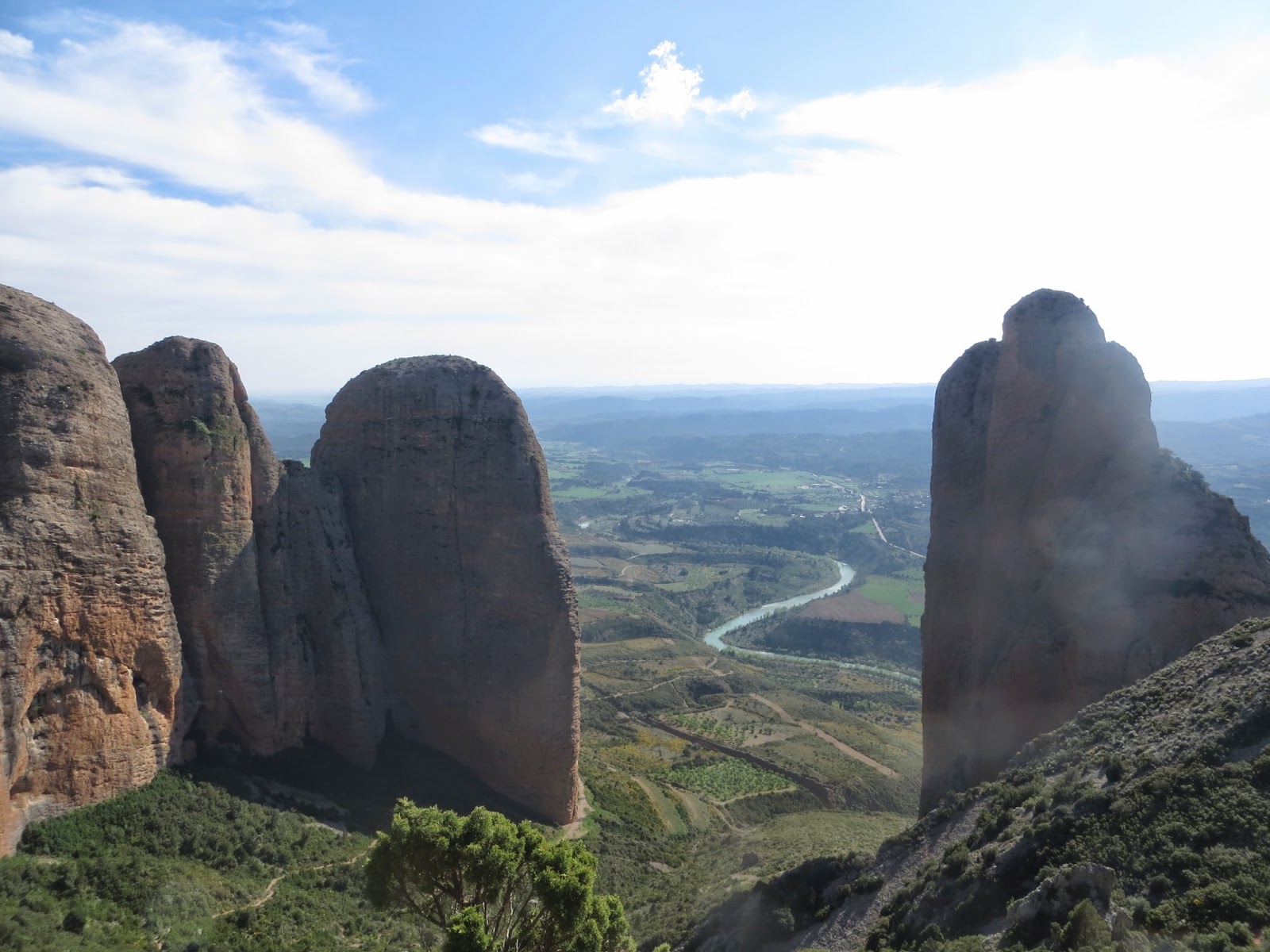
I was trying to think of some suitably impressive words to use to describe Riglos, but I can't so here's a photo instead:


The towers are about 300m high and are made of variously sized pebbles stuck together by a sandstone matrix. Close up, they look improbable, like a large pile of rubble that should fall down, but somehow doesn't. It's also home to the largest colony of griffin vultures in Europe - they circle around catching updrafts from the towers, making the place feel even more atmospheric.

We spend just under a week here, and were joined by Naomi (who also visited us earlier in Chulilla) and Charles (a climbing partner of Andy's from the Cheddar days). Andy and Charles had their sights set on some of the classic overhanging routes on Mallo Visera (Andy wrote about this here), so Naomi and I went exploring.

We had great fun on several days playing the fortunately/unfortunately game. It's not really much of a game - you just describe things that happened to you prefacing anything that went wrong with "unfortunately" and your solution to the problem with "fortunately". It amused me though, so I thought I'd write about our adventures in this style...

Day 1: unfortunately, on Naomi and Charles' first day there was a speed climbing competition going on in Riglos - routes had been allocated a certain number of points, and participants had to collect as many points as they could in a 12 hour period. This meant that the classic routes on the main towers were busy. Fortunately, the Mallos Pequeños (the smaller towers to the east of the main ones) were not included in the climbing competition, so we decided to head there instead. Pequeño is a relative term - the towers were still 100m high!

Mallos Pequeños (Aguja Roja is the one on the right)

We decided to do the Normal route on the Aguja Roja (graded 4+) as a gentle introduction to the strange rock. We made it up the first two pitches, despite some initial misgivings about the state of the rock - it turned out to be a lot more solid than it looked.


Crazy rock, before the rain...
...and after

Unfortunately, when Naomi was leading halfway up the fourth pitch (having decided to join the third and fourth pitches together) there was a crash of thunder and the heavens opened. Fortunately, we were highly resourceful, and organised a quick and efficient retreat, abseiling down in torrential rain which then turned into hail. The storm only lasted about 30 minutes, but, unfortunately, the rock was soaked and we were too. Fortunately, the sun came out afterwards so we squidged back to the village and steamed dry in the sunshine.

Day 2: with an earlier start, a more stable weather forecast and an absence of speed climbers, we set our sights on a bigger objective on the main Riglos towers - the Travesia de las Cinco Puntas del Mallo Firé (also graded 4+). The Firé is the west-most of the main towers, and has a distinctive, many-peaked ridge line along the top. Unfortunately, as seen from the east during the walk up from the village, it looks intimidating and impenetrable.

Mallo Firé

Fortunately, there's a sneaky easy route round the back that allows access to the ridge at an amenable grade. From there, the route goes to the top of peaks Montolar, Mallefré, Mateo and the tiny subsidiary peak of Buzón, before finishing on the slightly disappointingly named Punta de No Importa.

Unfortunately, our rope was too short to get all the way to the end. Fortunately, I decided this was close enough...

Unfortunately, taking in so many peaks meant that the route was quite complicated - lots of climbing up, abseiling back down, and some devious route finding. Fortunately, we formed an efficient and honed climbing team so this was no problem - we ticked off all the peaks, enjoyed some amazing views, saw some vultures and made it back down in time for a lovely meal at the Refugio.

Day 3: unfortunately, after the exploits of day 2, we were both tired. Fortunately, it was a lovely day and the shop in Riglos sold ice cream. We lazed in the sun taking many photos of Andy and Charles climbing the normal route on the Mallo Puro (it was Charles's last day so they'd decided to push through the tiredness). Unfortunately (for them), we mischievously decided to steal their shoes. Fortunately (for them), it turns out I'm not very good at subterfuge, and tend to crack under the pressure of devious questions such as "what's in the bag?" I don't think I'm cut out for a career as a spy...

Mallos Puro (the pointy bit on the left). Andy and Charles are just reaching the top - can you see them?

Day 4: Charles had to leave, so Naomi and I teamed up with Andy to climb Moskitos, a seven pitch route on Mallo Visera. This is a sneaky route that gets you into some similar positions to the famous harder routes up this wall (Fiesta de Los Biceps and Zulu Demente - see Andy's blog), but weaves around to avoid most of the steepness so is a much more amenable grade (6b/6b+, depending on which guide you read). The first few pitches were really fun: some interesting crack climbing, followed by an airy traverse across to the 'Trone', a car-sized boulder improbably wedged two-thirds of the way up the tower.

Naomi on the traverse pitch of Moskitos

Unfortunately, the sun hit the crag at this point, and we'd all underestimated the effect of the heat on climbing performance. The crux pitch leaving the Trone was a bit of a struggle and I had to pull on pretty much all of the bolts to get up it. Fortunately...erm......I made it in the end, we didn't have to do a complicated abseil retreat, and I learned a valuable lesson about the importance of staying hydrated... The walk down from the top was spectacular.


We were ravenous when we got down, so enjoyed some well-earned tapas and ice cream at the bar, and watched some base jumpers being silly...

Day 5: exhausted! We drove to Santa Ana, near Lleida, intending to do some more conventional single-pitch sport climbing, but instead ended up eating tasty food and paddling in the (very cold) river.

Overall, Riglos was an experience - a spectacular place, and a very different style of climbing from what we were doing before. I left feeling very inspired to come back in the future, but will have to get a lot fitter first!!

Sunday, 6 April 2014

Hiking in the Pallars Jussa

One of the things that makes being injured a bit less annoying is that it gives you time to do some other things that normally get pushed out by climbing.  One of these is hiking - I'd intended to do a bit of it on this trip, but up til now climbing and the associated faff had been taking up all our time.  As it turns out I almost couldn't have picked a better place to do it if I'd tried!

The county of Pallars Jussa is situated in the Iberian Pre-Pyrenees.  It's a beautiful landscape of Pre-Pyrenean mountain ranges split by deep, rocky valleys, with stunning views of the snow-capped Pyrenees themselves on a clear day.  The county consists of two main sections either side of the town of Tremp: Serra de Montsec on the southern edge, and Vall Fosca (the Dark Valley) in the north.  We've been based around Montsec so far because that's where Terradets is, but hopefully we'll get to explore north at some point too.

There's loads of well-signposted, waymarked footpaths round here - the map we picked up from the tourist info in Tremp describes over 50!  We've only done three (routes numbered 2, 6 and 1 from the map, respectively), but they were all lovely.

Barranc del Bosc (8.7 km): This was a pleasant ridge walk that took a couple of hours one afternoon.  It passes underneath the 500 m high rock face of Roca Regina, then climbs the hill beyond to gain a ridge with some lovely views.  According to the sign board at the top, it's a good place to see eagles.  Based on the pictures provided, I think I saw a short-toed eagle flying past.  Or it may have just been a buzzard - but since we both forgot to take cameras on this walk you'll just have to take my word for it...


El Castell de Mur (8.8 km): This was another pleasant afternoon walk, with the added bonus that it went past not one, but TWO medieval castles!  Starting from the small village of Guardia de Noguera, we climbed up the steep hillside to reach the first castle, Castell de Mur.

This was the bigger of the two, and has things to see inside and a little museum attached.  Unfortunately, it was all closed when we got there - unsurprisingly since their opening hours appeared to be only Saturdays and Sundays, 11.30-13.00.  There was a little interactive information screen outside though that provided information on many aspects of Catalunyan culture, history and gastronomy, including some traditional Catalan recipes.  I was particularly intrigued by this one - a Catalan version of haggis, I think:
Intrigued to try this...


The walk continued gently along a ridge to the second castle, Castell de Guardia.  This one was a lot smaller and more ruined, but you could go inside and climb up a ladder to the first floor.  I got to do a royal wave from the window, so it was totally worth it:

Royal wave...

We then headed back down to Guardia de Noguera and started enviously at what I assume is the local cider making setup:


Ermita de Sant Salvador and Portella Blanca: The final route was a longer one (I'm unsure of the exact distance but it took about 5 hours) that climbed all the way up to the ridge of the Montsec de Rubies and down the other side, via the Ermita de Sant Salvador del Bosc.  This was reached by a route called the Camí de les 100 Corbes - I naively assumed this meant 100 steps (I'm sure I've done walks in the UK before that have been called 'the path of X steps') - I thought '100 steps will be easy enough, and an efficient way to gain height'.  It turns out 'Corbes' actually means 'bends' - it actually translates as the path of 100 switchbacks!  When a path's named after the number of switchbacks it has, you know you're in for a slog...  I quickly lost count of the number of bends, but some helpful individual had marked the number left to go at regular intervals.


There were also little stone shrines dotted along the path every so often, each with a picture of a different saint in it.


The Ermita itself wasn't particularly impressive, just a bricked up stone building - I'd have been pretty disappointed if it had been the only reason for walking up there.  The views, on the other hand, were amazing!

After the Ermita, the route continued up to the ridge (via a few more switchbacks!), and then along this to the Portella Blanca.  I had no idea what this was going to be - it turned out to be a big notch in the cliff on the south side of the ridge that allowed you to get down.

I was struck by the contrast in the vegetation on the north and south sides of the range.  On the way up I'd been walking up rocky paths through deciduous woodland full of moss-covered trees, ivy, and little purple flowers.  On the south side we were back to a typically mediterranean landscape - pine trees, spiky bushes and lots and lots of rosemary).

The route described by the map unhelpfully stopped at the Portella Blanca, possibly because the ridge of the Montsec de Rubies marks the edge of the county - the way down was therefore someone else's problem!  The route joined the GR1 long distance footpath at this point though, so I followed that until I found a sign pointing back to Font de les Bagasses, where we'd left the van.

Long-distance walking potential:
The second walk we did (the one with the castles) coincided for a while with another route marked with a mysterious red '8' symbol. The mystery was revealed when we found a signboard at Castell de Mur. We'd come across El Camí, a relatively recent long distance footpath (parts of it are still under construction) with the ambitious aim of connecting together all sites of cultural, historical and ecological interest in the Catalan speaking regions. The Pallars Jussa contains a 160 km section of it. I had a look at the full route on their website later - it's somewhere between 4000 and 5000 km in total and forms a rough figure of eight (the reason for the '8' symbol). I was quite surprised just how far the Catalan speaking region extends - north to Perpignan and as far south as Alicante on the mainland, and over the sea to the Baleriac islands. The whole thing seems to have been put together by volunteers and funded by donations, so it's quite impressive. Definitely something I'd be interested in doing more of if I came back to this region - the 0.1% we've done so far was very nice!


Saturday, 29 March 2014

Terradets broke me (but it's pretty)

Since Barcelona, we've been exploring inland Catalunya - first the province of Tarragona, then further north to Lleida. Although Catalunya's quite a big place (about the size of Wales), most of the population lives in the coastal cities of Barcelona, Tarragona and Girona. The inland areas are sparsely populated, very pretty and rural and, most importantly for us, full of rock.

We visited three different places in Tarragona:

  • Margalef - powerful pocket climbing on towers of conglomerate rock with our friend Adam, who we meet on our way south.
  • Arboli - more conventional limestone climbing in a beautiful setting. Sector El Falco in particular has stunning views over the valley to Siurana and Montsant.
  • Montsant - more conglomerate rock, but with bigger and more positive pockets than Margalef. The climbing's less about power and more about endurance.
El Falco at Arboli
Andy has written about these in more detail. I've mainly been trying to relax a bit after my head issues earlier in the trip. I've had some good days climbing when my head's been working well, but also several days just enjoying the glorious sunshine and the scenery. I had a really good day at Arboli though (pink trouser power!) and managed my second 6a onsight of the trip.

About a week ago we moved north into Lleida province, starting with Terradets. It is beautiful here, with the Pyrenees visible in the distance on a clear day. It's an area we've not visited before, so we were keen to explore. Unfortunately, I've had a bit of a setback...

After traveling, we thought it would be a good idea to have a relaxed first day and do some easy multipitch - with hindsight, a big mistake.  The route we chose, a 200m 6b called Smoking, turned out to be, as our friend put it, "a bit spicy".  I had hoped to lead a few of the easier pitches, but backed off the first (grade 5) pitch, because it only had about 6 bolts in 30 m and the climbing felt much harder than the other 5s I'd done that week.  Andy put in big effort to lead the 2nd pitch (supposedly 6a!), which involved some savage pulls on tiny finger rails using insecure footholds, where the bolts were again generously spaced. He actually power-roared at one point - not something that's happened on a 6a for several years.

My attempt at seconding was much less successful.  At a blank section where the holds were extra tiny, I tried to stand up on a really awful foothold, but the rucksack I was carrying threw off my balance, and I ended up pulling really really hard on some tiny handholds to compensate. There was a loud, crunchy sort of noise, and suddenly it hurt to pull on anything with my left hand. I scrabbled and whimpered up to the belay, then demanded to go down - there was no disagreement from Andy.
Sad hand...

According to my internet research I've damaged the A4 pulley in my left ring finger - a classic climber's injury (I know damaging A2 is more common, but the pain seems to be concentrated round the second knuckle, not the first). Pulleys keep the finger tendons running along the bone when the fingers are bent, but crimping (pulling with fingers bent at an extreme angle) too hard can overload them. The advice from the internet seems to be ice and rest and no climbing for 1-3 weeks, followed by a gradual reintroduction. It's quite a specific injury - it only hurts if I crimp but not if I pull in a more open-handed way - but the important thing is to not accidentally aggravate it again before it's healed and make it worse.

It's been just over a week since I did it now, and the swelling's gone - I can get my engagement ring back on! I was going to try it out on some easy climbing today, but this morning the wind was gusting so much that the van was rocking on its springs, so might leave it a bit longer.

Witches Wall
In the meantime, I've been belaying Andy on his project at the excitingly named Witches Wall, and we've found a whole new, multinational circle of friends - other Witches Wall devotees. We've also done some of the many lovely walks round here - I think this deserves a post of its own. So I've been keeping busy. And in scenery like this you can't complain too much, can you?
View over Embassament de Terradets

Thursday, 13 March 2014

Barcelona (for the cactus enthusiast)

This week, Andy turned 30. Since this is apparently when life begins, we thought we ought to celebrate. So we took a little break from the climbing van dirtbag lifestyle and spent a few days staying in an apartment in Barcelona with family and friends. We'd specifically set aside a part of the trip budget for this as our joint birthday and Christmas presents to each other, but I did get Andy a magnetic lizard on the day too.

We spent a lovely few days eating too much and did a range of touristical things. We did well - in four days we sampled several varied sides of Barcelona: Las Ramblas, a castle, the gothic quarter, the Gaudi architecture and the seafront. However, when I looked back through my photos I found that most of them seem to be pictures of cacti. Anyway, here is what we got up to - where appropriate I've put in links to pictures of the sights of Barcelona taken by better photographers...

Day 1: we wandered up Las Ramblas, and had lunch while we waited for our party to become complete. Later we walked over to Barceloneta, and had seafood in a restaurant near the sea. We then walked back to Las Ramblas and stopped in a bar on the edge of the old town to order a beer. We got a bit more than we bargained for...
That's a half-size wine bottle, but still...

Day 2: a slow start due to the massive beers of the previous evening. We bravely headed out at about lunchtime to visit a fort in Parc de Montjuïcs that's on top of a hill looking out over the sea. There is a cable car that takes you up the hill, but one of our group refused because "I don't understand how they stay up", so we walked. This meant that we went through the botanical gardens, including one garden comprised entirely of lots of different types of cactus. This is where I took most of my photos.

Wild west...
Round cactiFuzzy cacti
These ones made cool shapes
These ones have flowers

At the top, we didn't go into the fort because it was expensive and there was a queue, but we did have some good views out over the sea (although mainly the cargo port). Again though, my photos mainly focus on cacti - we noticed an unusual type of graffiti where people had written their names on the leaves of the clifftop aloe vera plants.
The view...
...and the cactus graffiti
We then headed back down the hill and stopped for coffee at a quirky coffee shop with construction site themed decor. The walls were decorated with hazard tape, construction signs and toy tools and, most entertainingly, there was a skeleton in a hi-vis jacket installed at one of the tables reading a map! They did very nice pastries too (I forgot to check what the place was called but it was just down the road from Paral-lel metro station).

A long-term customer...?
Fueled by coffee and pastry, we caught the metro up to the Sagrada Familia, the unfinished cathedral designed by Gaudi. It's pretty impressive and weird, and I utterly failed to get any decent photos of it. Since it's pretty famous though, here's a link to some official ones.

We celebrated Andy's birthday that evening - a day early but some of the others had to leave the next day. We had some fancy cocktails (courtesy of Andy's mum - thank you!!), then dinner in the old part of town.

Day 3: Andy's actual birthday. We started off with a tapas lunch on La Rambla. The set menu at the restaurant we picked seemed surprisingly reasonably priced. The catch turned out to be that if you ordered a beer or sangria it came in a glass as big as your head and was very expensive! Slightly wobbly from all the sangria, we wandered over to look at Barcelona's other cathedral (the old gothic one), then went to Park Güell to look at some more Gaudi architecture.
More enormous drinks...
Day 4: we went to the beach. I dug a really deep hole! We then sent some time wandering along the seafront, and had ice cream.
Yay!!
Overall, it was a fun trip back to civilisation. We're in the van again now and have been easing ourselves back into climbing. We spent our first night back in the van near Cornudella de Montsant, about 2 hours inland from Barcelona. In the morning we went to the cafe and sat near some other climbers, then we went to the climbing shop - Andy got some new climbing shoes and I bought some awesome pink trousers! We then stood near some rocks in Siurana to have lunch - someone Andy knew was out with a group of friends so we stood and chatted for a bit and watched them climb. Finally, at about 5 pm, we arrived in our intended destination, Margalef, and I climbed some mini-routes (just over 10m long) until it got too dark to see the footholds.